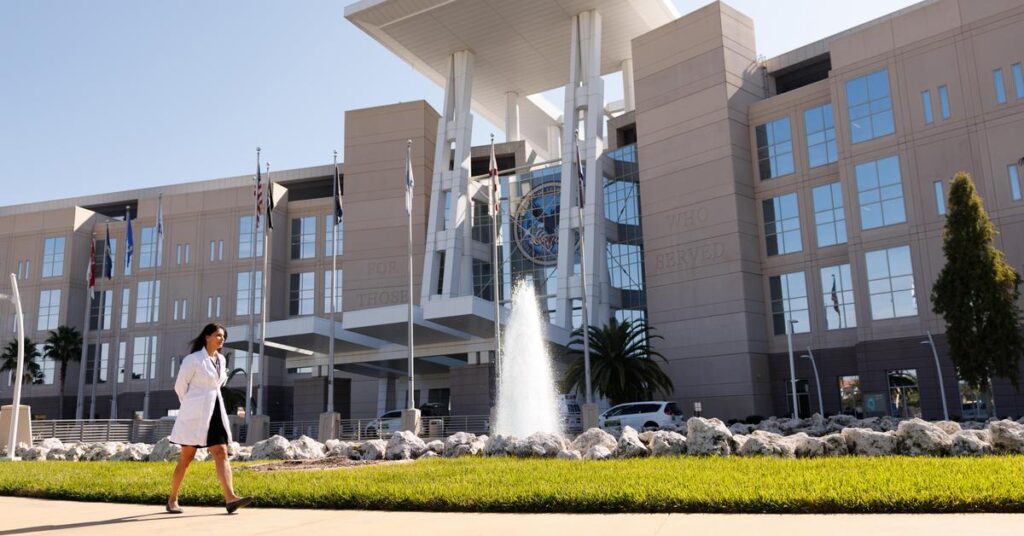
Researchers in Lake Nona’s thriving health and life sciences cluster are using microgravity to study changes associated with aging and explore new approaches to developing medicines.
Why can a flight of stairs feel harder as we get older? Losing muscle strength is part of the answer. Understanding what happens inside that weakening muscle could help researchers find ways to protect it. For a closer look, some scientists are sending human tissue into space.
The connection starts with gravity. Here on Earth, your muscles work to hold you upright and carry your weight. In microgravity, the near-weightless conditions of orbit, much of that daily workload disappears. Muscles can weaken rapidly, developing changes that resemble some of those seen with aging. For researchers, that offers a chance to investigate a slow-moving problem on a shorter clock.
Dr. Siobhan Malany, a drug-discovery pharmacologist at the University of Florida, is pursuing that possibility from Lake Nona, near Kennedy Space Center. Her career has been spent searching for ways to develop medicines. Space gives her another environment in which to look.
Her work offers a window into Lake Nona’s growing role in space-related health research. Her muscle experiments have brought together UF scientists, collaborators at AdventHealth and commercial space companies — connecting medical research on Earth with experiments in orbit.
Dr. Malany questions extend beyond muscle loss. She is also exploring whether space can improve cells’ ability to produce the tiny packages of repair signals that researchers hope to turn into more effective therapies. Watching tissue deteriorate at a faster rate and learning how to help it heal bring her back to the same question: what could these microgravity-influenced experiments make possible for patients on Earth?
The gravity of aging
Astronauts aboard the space station exercise for about two hours a day to help protect their muscles and bones, according to NASA. Spaceflight can also affect heart function, metabolism and the way cells behave. Some of these changes resemble conditions doctors see every day in older adults on Earth.
Dr. Malany and her colleague Dr. Maddalena Parafati use engineered human tissue models sent into space to study aspects of aging on biological fast-forward. These miniature 3D models are grown from small tissue samples donated by both younger and older volunteers. They sit inside compact, enclosed devices that supply nutrients in fluid and can operate with limited human help. Researchers can compare them with samples kept on Earth to investigate how spaceflight affects a particular tissue.
In a recent study, her team used small electrical pulses to make the lab-grown muscle tissue contract. Tissue grown from younger donors was particularly affected by spaceflight. It showed a drop in its ability to contract and many changes in genes associated with aging, compared with both samples kept on Earth and samples from older volunteers in space.
As director of UF’s In-Space Biomanufacturing Innovation Hub, Dr. Malany also helps other researchers across the university develop projects for spaceflight. The hub brings together scientists from fields including pharmacy, engineering and food and agricultural sciences. It supports their work with funding, training and partnerships with commercial space companies. These efforts include experiments involving human cells, bacteria and even plastics, as well as tests of payload hardware on suborbital flights, parabolic flights and missions to the International Space Station.
Expanding frontiers
Dr. Malany’s work extends into several other areas, each exploring a different way spaceflight could advance medicine:
Repair signals from cells (extracellular vesicles): She’s testing whether cells can produce extracellular vesicles (tiny packages that carry repair signals between cells) more effectively in space. These vesicles could become nanomedicines or regenerative therapies, but manufacturing them at scale remains a major limitation on Earth.
She believes 3D cell behavior, altered fluid dynamics and stress responses in microgravity may improve their quality, offering one path toward space-grown materials that repair tissue, regenerate cells, and power new therapeutic platforms.
Therapeutics and muscle health: Another area of focus is testing compounds that may prevent muscle atrophy, including natural products and antioxidants. The aim is to identify new ways to protect long-term health. Dr. Malany is studying whether microgravity can reveal how these compounds influence muscle loss, offering insight that could potentially help address a known side effect for the millions of Americans on GLP-1s.
A stem cell bank from astronauts: Dr. Malany is also creating a stem cell bank using samples collected from astronauts before and after spaceflight. These cells can be grown into any cell type, including muscle, heart, kidney, liver and brain cells. The goal is to determine how space changes cells and cell-to-cell communication, and whether those changes persist after the astronauts return to Earth. Rather than limiting each research project to a single flight or a small set of samples, this would create a reusable scientific resource for future studies.
Space for more than one scientist
One experiment in space is only a starting point. Turning promising findings into potential treatments takes repeated testing across missions and people who can help carry the work forward.
Dr. Malany’s muscle research shows how these partnerships work. Collaborators at AdventHealth helped provide donated tissue for the experiments. Micro-gRx, Inc. developed the fluidic chip, which is the size of a thumb drive. SpaceTango worked with her team to design the compact laboratory that supplied the tissue with nutrients and recorded its contractions in orbit. Getting living tissue into space required medical research and spacecraft engineering to come together.
Dr. Malany also brings researchers and potential partners to Lake Nona through UF’s annual Biomanufacturing in Space Symposium. The next gathering, on November 12, 2026, will feature research on new therapies, diagnostics and recycling processes. Discussions will explore how companies and academia can work together to support scientific work and advance commercialization platforms in orbit.
As human spaceflight expands, so does the need for professionals trained to address its health challenges. In Lake Nona, the University of Central Florida College of Medicine will launch a Master of Science in Aerospace Medicine in fall 2027. The program will provide formal graduate training to support human spaceflight across government, commercial, research and international sectors.
“We see Lake Nona as a place where emerging fields of science can take root, converge, and expand the possibilities for human health,” said Dr. Ally Silverton, Chief Medical Officer, Tavistock Development Company. “Lake Nona offers a uniquely powerful environment for integrating biomedical science, medicine, engineering, artificial intelligence, simulation, and space research into a single, highly collaborative ecosystem. Building a research community means taking that long view and creating the conditions for scientists like Dr. Malany to challenge assumptions, investigate fundamental biology and pursue discoveries that redefine what is possible in medicine.”
Better health on Earth
Malany’s work is still experimental, but its purpose is rooted in the needs of patients on Earth. Understanding muscle deterioration could help researchers find ways to preserve strength. Learning how cells produce repair signals could advance biomanufacturing in low Earth orbit (LEO) and contribute to treatments that help damaged tissue heal.
Turning those possibilities into medicines will take further research. For Malany, the long-term goal is to make what scientists learn in space useful to people whose health depends on the next advance here on Earth.